

This post comes to you as an ongoing exploration of Susan Eichhorn’s most recent post on her blog about athleticism in singing (see it here: https://susaneichhornyoung.com/blog/2025/8/are-you-thinking-like-an-athlete).
I have spent a lot of time thinking about what athleticism means in terms of voice training. How that shows up in my own singing and in my studio. I realize there is no one answer because, as singers, our athleticism is actually an interconnected web of external and internal processes. Also, our uses for certain types of athleticism vary depending on our situation. We do often study the biomechanics of singing. And that could be considered a type of athleticism we engage in. But the pursuit of singing calls us to perform a wide range of muscle processes as we sing and move about on stage. So, as singers, we really must train our bodies in a variety of different ways in order to bring the entire body and voice in line for performance.
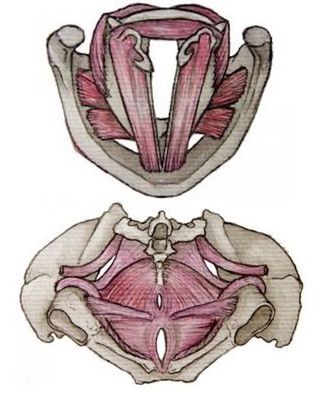
This brings me to today’s topic. Elite athletes run drills. Each drill is designed to address a specific movement or coordination, or to strengthen a set of muscles for a specific task. Much of what these athletes do falls under the category of functional exercise. The modern singer needs to also spend some time working on their voice and their body in the way top athletes do. By using exercises that help to unlock tensions and/or build or strengthen muscles so that they can function in a healthy and balanced, interconnected way. But the only way to achieve this is to address certain functions separately first. Later, you can integrate and fine tune. So today I want to shine attention onto the jaw-pelvic floor connection. One area that singers can better coordinate even just by having more knowledge about the interplay between jaw and pelvic floor.
If you have been singing for any length of time at all, you know that the jaw is super important to the way our voices function. Tight jaws hinder good production. But just thinking “loose jaw” isn’t a cure all either because of the interplay of functions in our bodies. You’ve probably also heard how you need to “connect to the pelvic floor,” aka, the lower abdominals or the sitz bones (people use a lot of different prompts to help to get that pelvic floor firing). Yet, it often remains elusive.
I thought it would be worth it to share some videos I found that explain this connection. Being more conscious of this connection could be beneficial for some. Peruse these links below and consider how your own body and physiology relate to these ideas. But don’t worry if you find this too “mechanical” for your tastes or too “woo woo”… that’s fine. As always in my studio, if it resonates and helps you feel something, that’s great! If it doesn’t… skip it. Perhaps you need a different way to approach this information. And that’s perfectly fine!
Check these out and let me know what you think.
xoxo, Celia
On Instagram, 2 reels discussing this jaw-pelvic floor connection
https://www.instagram.com/p/DHzK0avsHyz/
https://www.instagram.com/reel/DHaQ-sDp8aP/
————————————————-
A TikTok video with an exercise for stretching the tongue to help release jaw tension and feel the pelvic floor:
https://www.tiktok.com/@jules_horn/video/7534745394144677133
————————————————-
On YouTube: If you really want to go more in-depth, here is a full class on the subject!
 using WordPress and
No responses yet